The Necklace
Overview & Design
A close feature study of the necklace's silhouette, diamond configuration, gold and enamel work, carved emerald drops, and its place within Mughal artistic tradition.
Overview
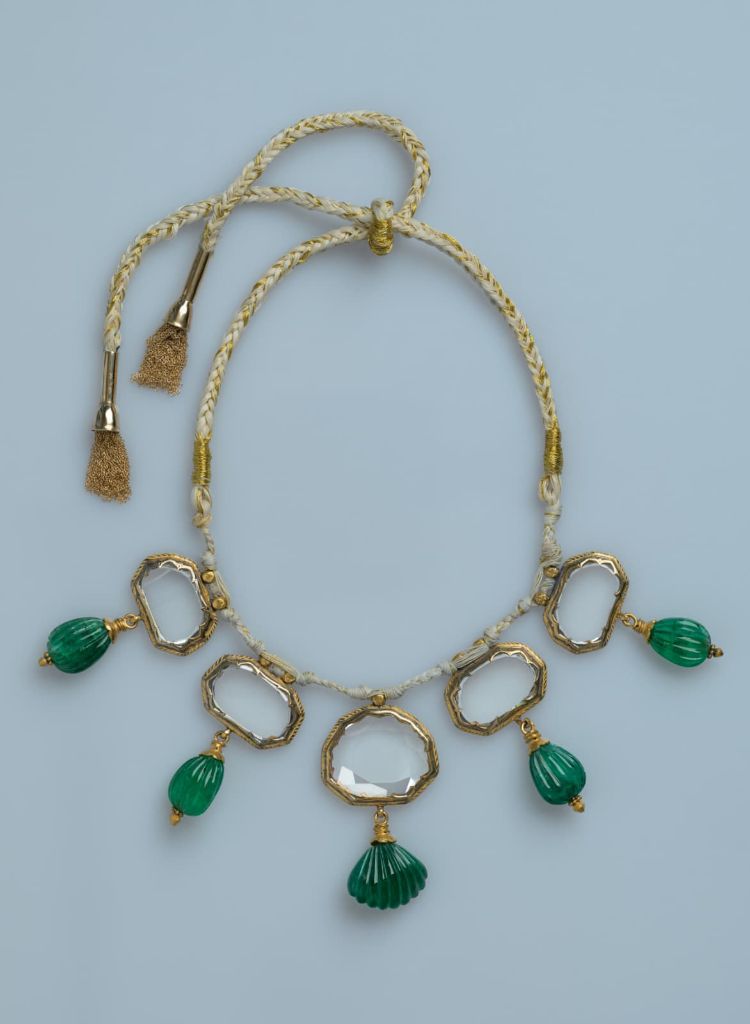
A necklace built around five mirrors of light
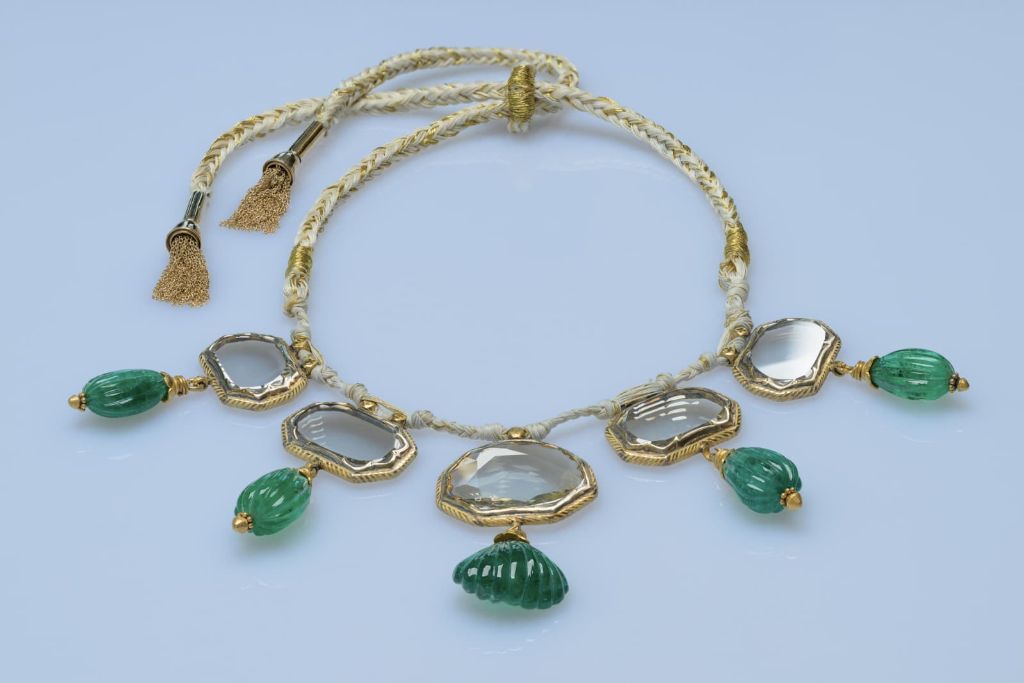
The Mughal Mirror Diamond Necklace is constructed around five principal diamonds, each cut flat and broad in the table-cut, "parab," or portrait-cut tradition. The stones are graduated in size, with the largest positioned at the centre, and are set in gold frames finished with white enamel. Below four of the frames hang carved emerald drops; the central frame carries a larger, fluted emerald in a shell motif. The whole is suspended on a braided cord of silk and gold thread, finished with gold-wire tassels — a construction consistent with Mughal jewelled necklace design of the period documented in the supplied curatorial material.
Design & Silhouette
A graduated arc of light and colour
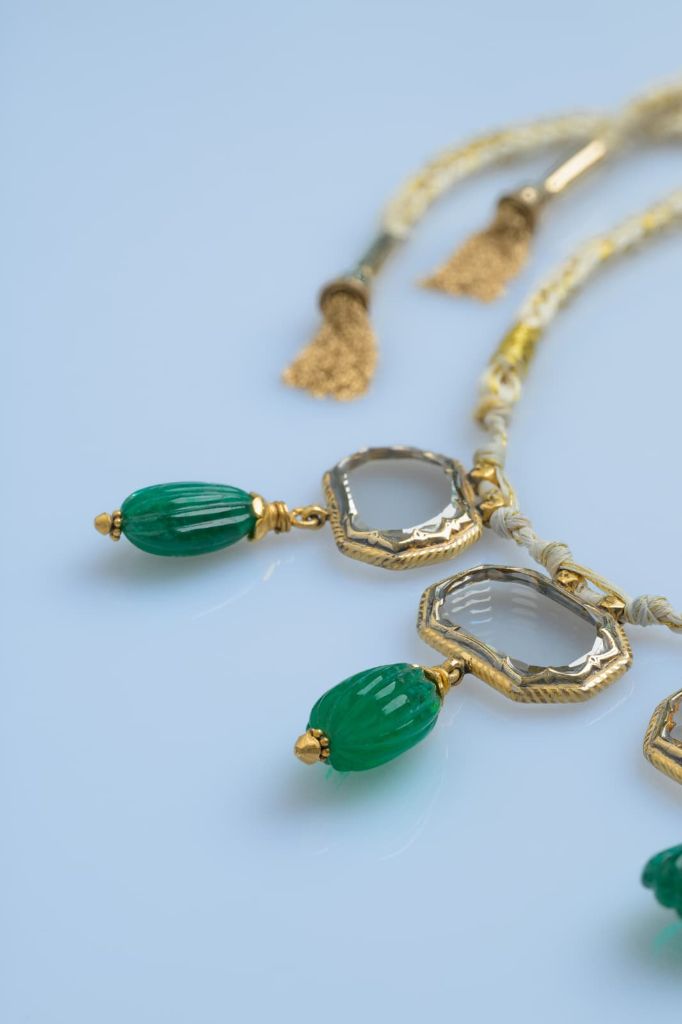
Worn, the necklace forms a graduated arc: the diamonds increase in scale toward the centre, drawing the eye to the largest table-cut stone and its pendant emerald shell. The two braided cord strands finish beyond the clasp in matching gold-thread tassels, a detail that extends the necklace's silhouette and echoes the gold used throughout the diamond frames.
The overall proportion favours the diamonds as flat, luminous planes rather than faceted brilliance points — a distinctly Mughal design choice that treats each stone as a reflective surface within an architectural gold setting, rather than as a light-scattering gem cut for sparkle in the later European sense.
Diamond Configuration
Five flat Golconda table-cut diamonds
The five principal stones are documented as flat, table-cut diamonds of Golconda origin, together totalling approximately 97 carats. Their scale and matched character are cited in the supplied curatorial and gemological material as a rare surviving configuration.
Stone Count
Five principal table-cut diamonds, graduated toward a larger central stone.
Cut Style
Flat table-cut, also documented as "parab" or portrait-cut — a Mughal-era lapidary tradition.
Origin
Documented as Golconda diamonds, historically the principal diamond source of Mughal India.
Total Weight
Approximately 97 carats across the five principal stones, per the supplied documentation.
For a deeper explanation of this cutting tradition, see Understanding Parab and Portrait-Cut Diamonds in the Knowledge Base.
Gold & White Enamel Work
Frames finished with fine white enamel
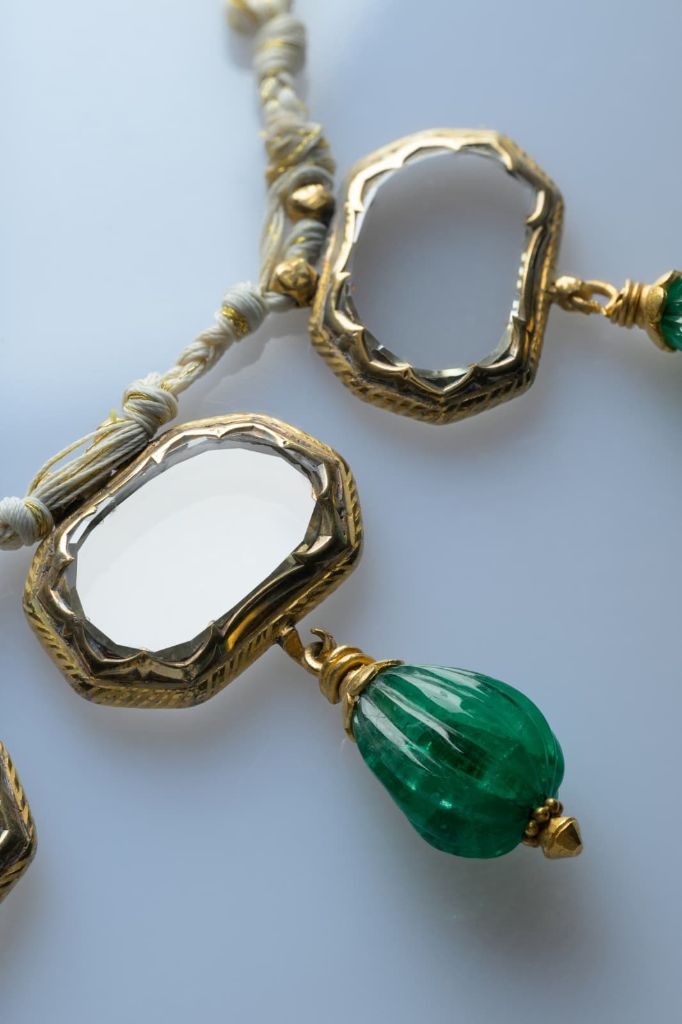
Each diamond is held in a shaped gold frame, its edges chased with a rope-like border and finished in white enamel — a decorative technique the supplied documentation identifies as characteristic of fine Mughal jewelled work of the period. The enamel provides a crisp, pale border that frames the cool luminosity of each diamond and unifies the five settings into a single visual composition.
Read: Gold Frames and White Enamel Decoration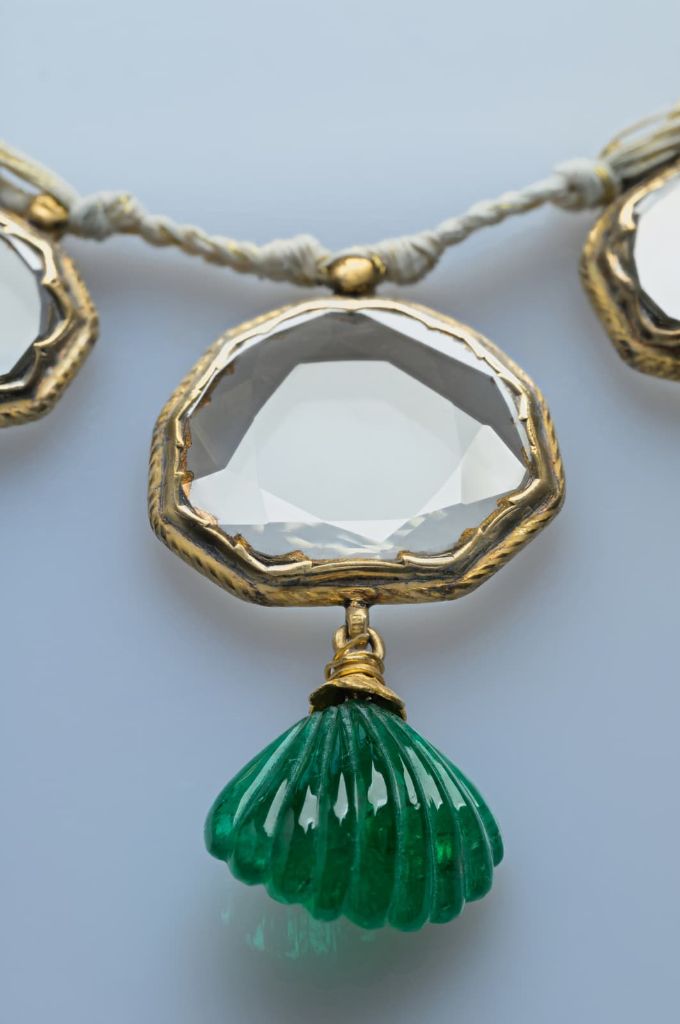
Carved Emerald Drops
Sculptural colour beneath every mirror
Below each of the five diamond frames hangs a carved emerald drop. Four are fluted, lobed forms in a warm, saturated green; the fifth, at the centre, is carved as a shell — the necklace's single largest and most sculptural pendant element. Together, the emeralds provide the necklace's principal note of colour, balancing the cool, mirrored diamonds above.
Read: The Carved Emerald DropsMughal Artistic Context
Within the tradition of the Shah Jahan court
The supplied scholarly material situates the necklace within the jewelled arts associated with the Shah Jahan period of the Mughal Empire — an era noted for its patronage of large, fine Golconda diamonds, sophisticated goldsmithing, enamel decoration, and carved gemstone work. The necklace's combination of these four elements in a single, coherent design is discussed in the documentation as reflecting the refined aesthetic sensibility of that court tradition.
Diamond Patronage
Golconda mines supplied the Mughal court with large, fine diamonds prized for size and clarity.
Goldsmithing & Enamel
Fine gold chasing and white enamel decoration were hallmarks of Mughal jewelled settings.
Gemstone Carving
Carved emerald and hardstone work reflects a broader Mughal tradition of sculptural lapidary art.
Historical Significance
Why this necklace matters
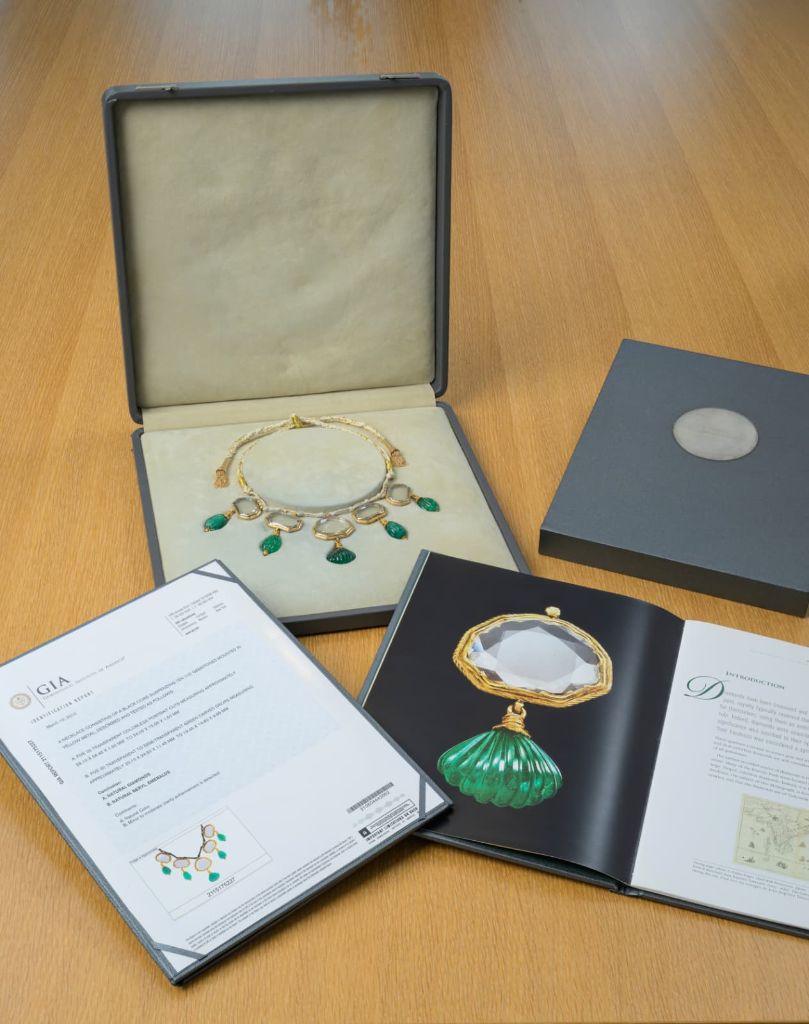
The supplied documentation points to several factors that, together, are described as making the necklace exceptional: the survival of five large, closely matched table-cut Golconda diamonds within a single jewel; the intact presence of gold, white enamel, and carved emerald work in one composition; a documented and continuous provenance; supporting gemological documentation, including a GIA identification report; and, more recently, public recognition through Christian Dior Couture's 2026 citation of the necklace as a design reference for its haute couture collection.
Read the Full History & ProvenanceGallery
Detail Photography
Select any image to view in detail.
At a Glance
Key Characteristics
- Period
- 17th century
- Style
- Mughal
- Principal Stones
- Five flat Golconda table-cut diamonds
- Approx. Total Diamond Weight
- 97 carats
- Materials
- Diamonds, gold, white enamel, carved emeralds
- Cord
- Braided silk and gold thread with gold-wire tassels
Source: supplied curatorial summary and gemological documentation. See the full Knowledge Base for detailed sourcing.