Craftsmanship
The Making of a Mughal Masterpiece
An explanation of the flat table-cut diamond tradition, the gold and white enamel work that frames each stone, and the carved emerald craft that completes the design.
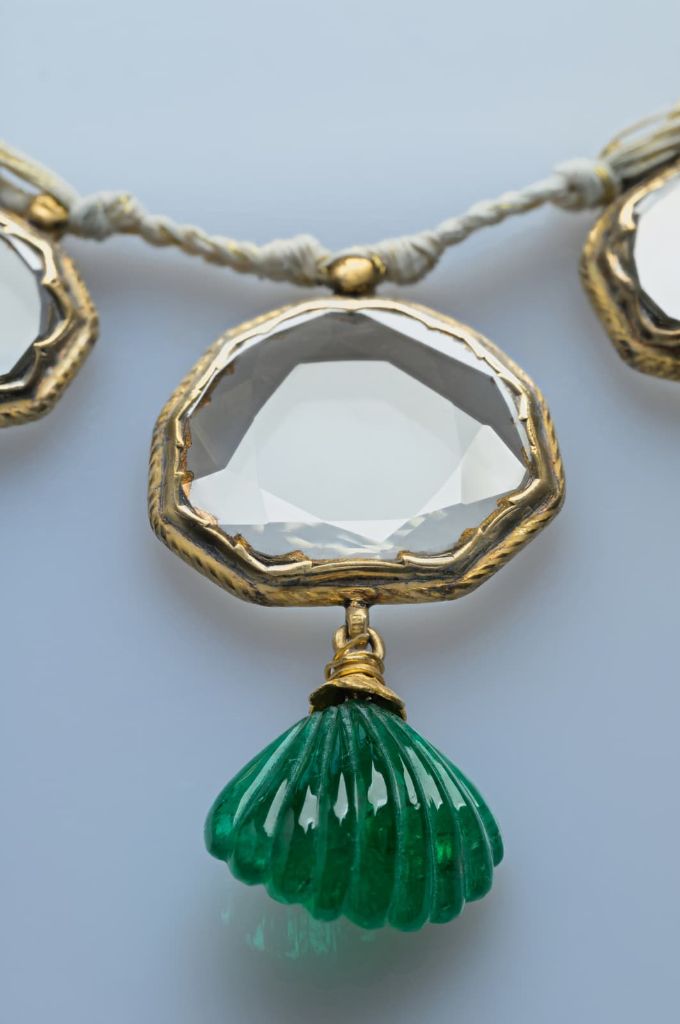
Cutting Tradition
Flat table-cut, "parab," and portrait-cut diamonds
The five principal diamonds are described in the supplied documentation as flat table-cut stones — also referred to as "parab" or portrait-cut diamonds. Rather than the many small facets used to maximise brilliance and fire in later Western diamond cutting, this earlier tradition preserves a large, flat top surface bordered by a shallow perimeter of facets.
The visual effect is markedly different from a modern brilliant cut: light is reflected across one broad plane rather than scattered into pinpoints, giving the stone a quiet, mirror-like luminosity — the origin of the "mirror" name used for this necklace. This cutting approach also preserved more of the rough diamond's original weight, a practical consideration when working with large, exceptionally fine Golconda material.
Historically, this style is associated with Mughal India, where flat-cut diamonds were set to be seen in reflected light — worn, displayed, and appreciated as luminous surfaces rather than sparkling points of fire. The supplied documentation identifies the necklace's diamonds within this tradition.
Reading the Cut
Table-cut vs. modern brilliant-cut, in principle
The diagram below is a simplified, educational illustration of the structural difference between a flat table/portrait cut and a modern faceted brilliant cut. It is provided for general orientation only and does not represent measurements of the necklace's specific stones.
Table / Portrait Cut
One broad, flat top surface with a shallow bordering bevel — maximises reflective surface area and retains rough weight.
Modern Brilliant Cut
Many small, precisely angled facets designed to maximise scattered light, sparkle, and fire.
Read further in Understanding Parab and Portrait-Cut Diamonds.
Materials in Dialogue
Gold, white enamel, and carved emerald working together
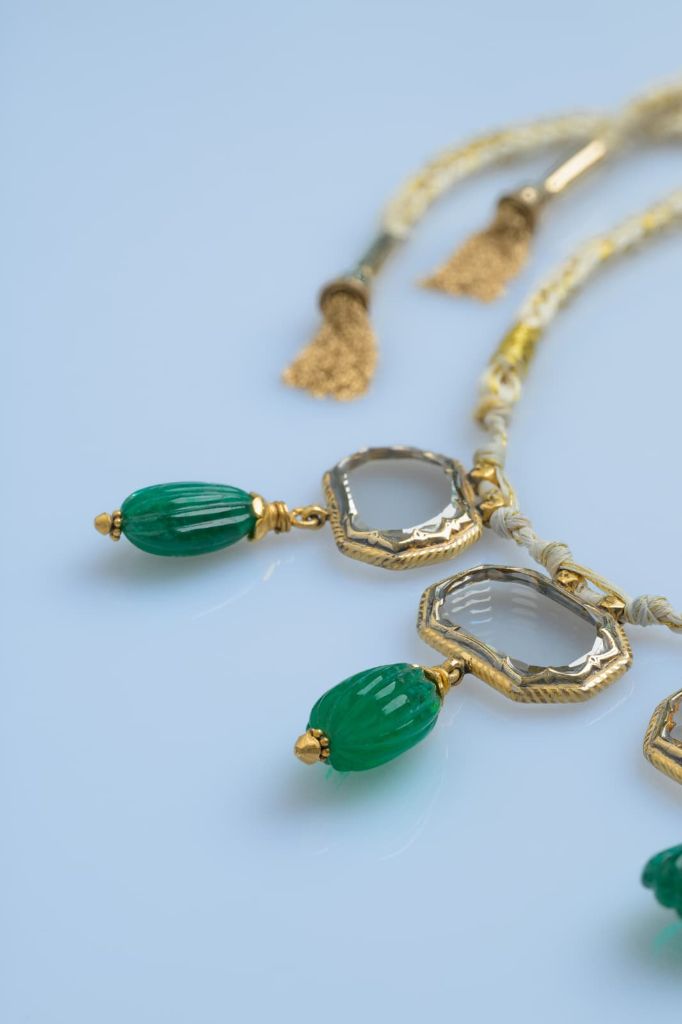
Each flat diamond sits within a shaped gold frame, its border chased and finished in white enamel — a technique that gave Mughal jewellers a way to introduce a crisp, contrasting edge around a stone without competing with its luminosity. The pale enamel border visually separates each diamond from the gold that holds it, keeping the eye on the reflective stone itself.
Beneath each frame, a carved emerald drop introduces saturated colour and physical weight, causing the piece to hang with intentional movement. The emeralds are lobed and fluted — carving techniques that catch light along their grooves — culminating in the shell-form pendant at the necklace's centre, the single most elaborately carved element of the piece.
Read more in Gold Frames and White Enamel Decoration and The Carved Emerald Drops.
Scale, Craft, Survival
Why this combination is exceptional
The supplied documentation identifies three intersecting factors behind the necklace's significance. None, alone, would be unprecedented — together, in a single surviving jewel, they are documented as rare.
Five Large, Matched Stones
Five flat Golconda diamonds of comparable quality and graduated size, totalling approximately 97 carats, surviving together in one jewel.
Four Techniques, One Design
Diamond cutting, goldsmithing, white enamel decoration, and gemstone carving are combined coherently rather than as separate later additions.
Intact Historical Condition
The documentation describes the necklace as retaining its original configuration, supported by gemological identification and a documented ownership history.
Continue Reading
Explore the full diamond configuration and construction on The Necklace page, or consult primary sourcing in the Knowledge Base.
Visit the Knowledge Base