17th Century · Mughal Empire
The Mughal Mirror
Diamond Necklace
A 17th-century masterpiece of Golconda diamonds, gold, enamel, and carved emeralds.
Introduction
A jewel of exceptional rarity and craft
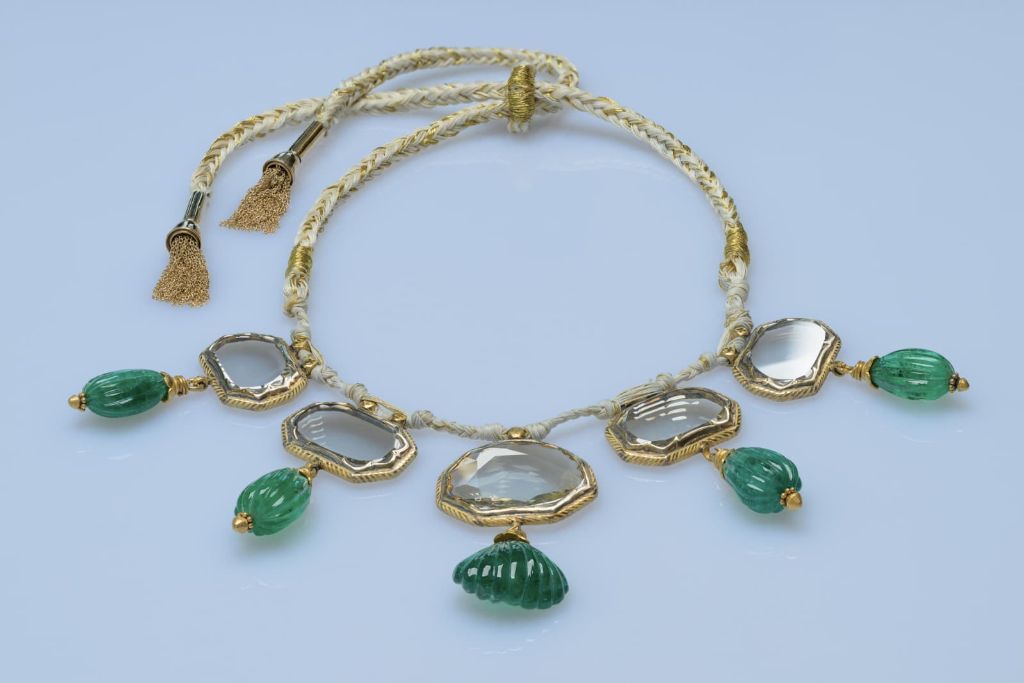
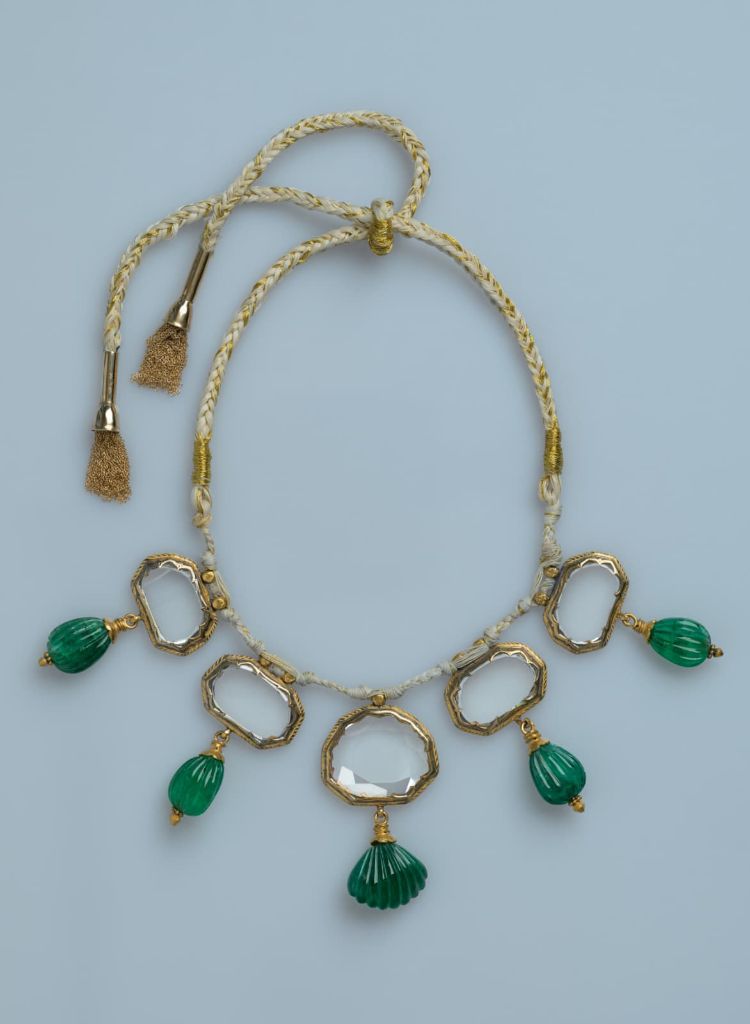
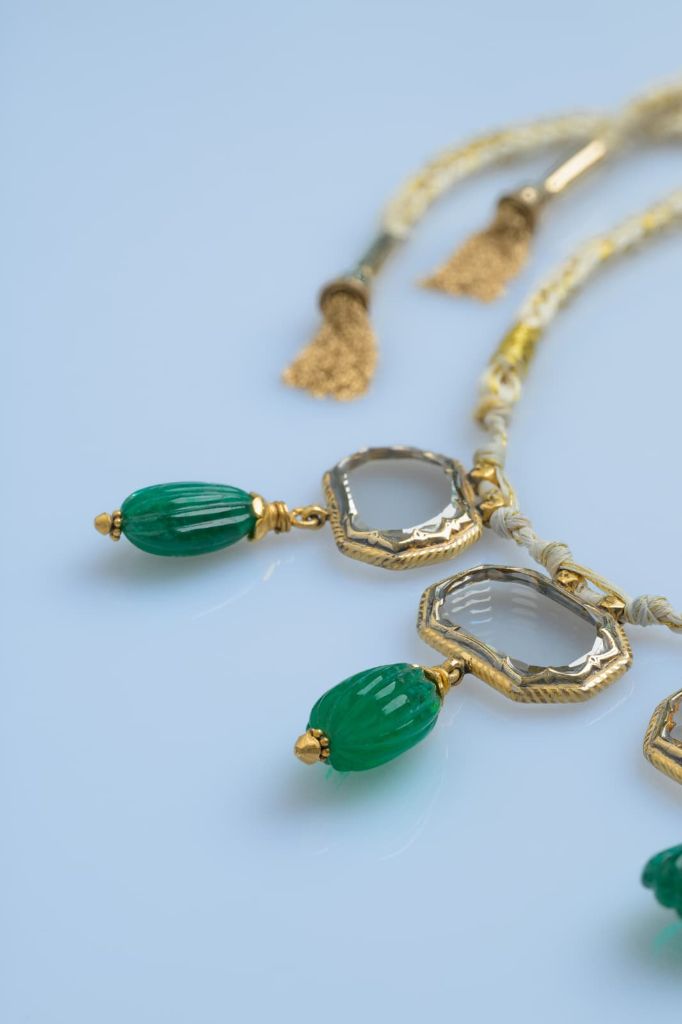
The Mughal Mirror Diamond Necklace is a remarkable jewel attributed to the seventeenth-century Mughal court, the era associated with Emperor Shah Jahan. It is composed of five flat, mirror-like table-cut diamonds — a cutting style historically prized in Mughal India for the way it multiplies reflected light across a broad, luminous surface — set within gold frames finished with white enamel decoration and completed by carved emerald drops suspended on a braided silk and gold cord.
Its scale, the survival of five closely matched principal stones, and the intact combination of diamond, enamel, gold, and emerald craftsmanship place it among the more significant documented examples of Mughal jewelled art discussed in the supporting scholarly and gemological material referenced throughout this site.
View Full OverviewFive Mirrors of Light
Five flat table-cut diamonds, one continuous surface of reflection
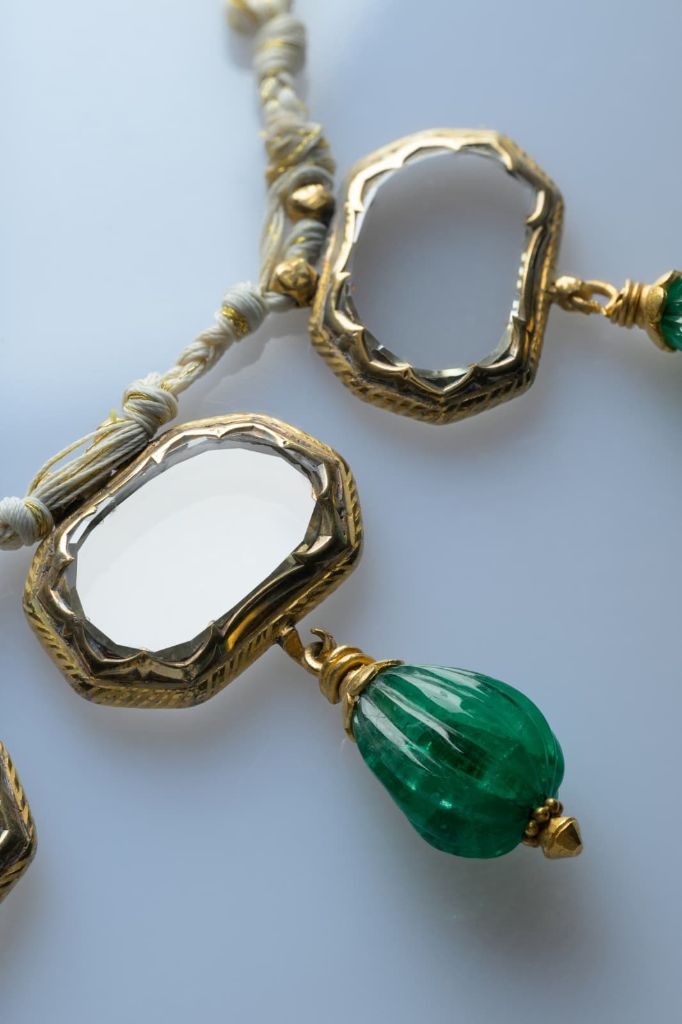
Each of the five principal stones is a flat, broad-faced diamond — described in the documentation as a table-cut, "parab," or portrait-cut stone. Rather than being faceted for brilliance in the modern sense, each diamond is cut to present a wide, mirror-like plane, a technique associated with Mughal-era lapidary practice and prized for its luminous, reflective character.
Together, the five stones are documented as totalling approximately 97 carats — an exceptional concentration of large, flat Golconda diamonds surviving intact within a single jewel. Learn more in The Five Golconda Table-Cut Diamonds.
Diamond · Enamel · Gold · Emerald
Four materials, one unified design language
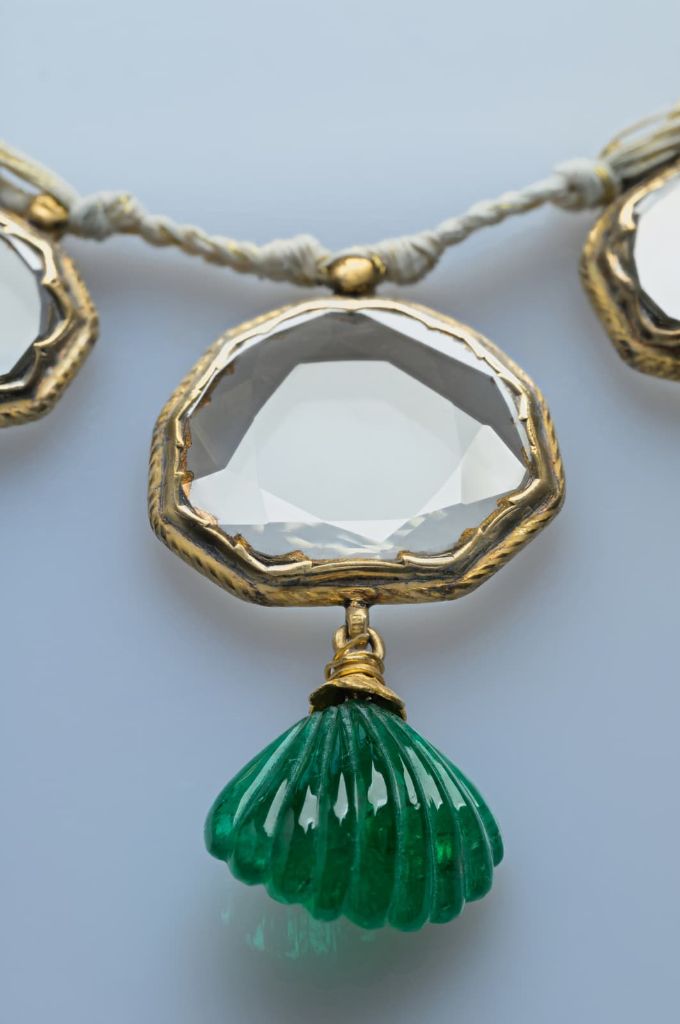
The necklace's character emerges from the dialogue between its materials. The flat diamonds provide a cool, mirrored luminosity; gold frames — chased and finished with white enamel — give each stone structure and warmth; and carved emerald drops introduce depth of colour and a sculptural counterweight, culminating in the fluted emerald shell suspended from the central mirror. The result is a composition where light, colour, and craftsmanship are held in careful balance.
Explore the CraftsmanshipCraftsmanship
Exceptional Mughal artistry, stone by stone
Table-Cut Diamonds
Five flat, portrait-style Golconda diamonds cut for reflective surface rather than modern brilliance — a hallmark of Mughal-era diamond working.
Gold & White Enamel
Each diamond is held within a gold frame finished in white enamel, a decorative technique documented as characteristic of fine Mughal jewelled work.
Carved Emerald Drops
Fluted and carved emerald drops — including a shell-form pendant at the centre — supply colour, volume, and a distinctly Mughal sculptural finish.
News & Recognition · July 2026
Dior Names the Necklace a Masterpiece of Islamic Design
In July 2026, Christian Dior Couture publicly cited the Mughal Mirror Diamond Necklace as the direct design reference for its 2026–2027 Haute Couture collection — a rare, high-profile act of public recognition for a historic jewel, documented in the supplied brochure and subsequent press coverage referenced in the supplied advisory memorandum.
“A masterpiece of Islamic design.”
An Unprecedented Endorsement
The supplied brochure describes this citation as a form of public validation with, in its words, "no true precedent for a historic jewel of this class" — noting that the necklace's prestige and historical value are characterised in that material as "intrinsic" and "unrivalled."
A Named Design Reference
Dior is documented as having named the necklace the direct reference for its 2026–2027 Haute Couture collection — a curatorial and design endorsement by one of the most influential names in global luxury, distinct from an appraisal, sale, or authentication.

Read the full, sourced account in History & Provenance or the Knowledge Base article.
History & Provenance
A documented lineage, carefully sourced
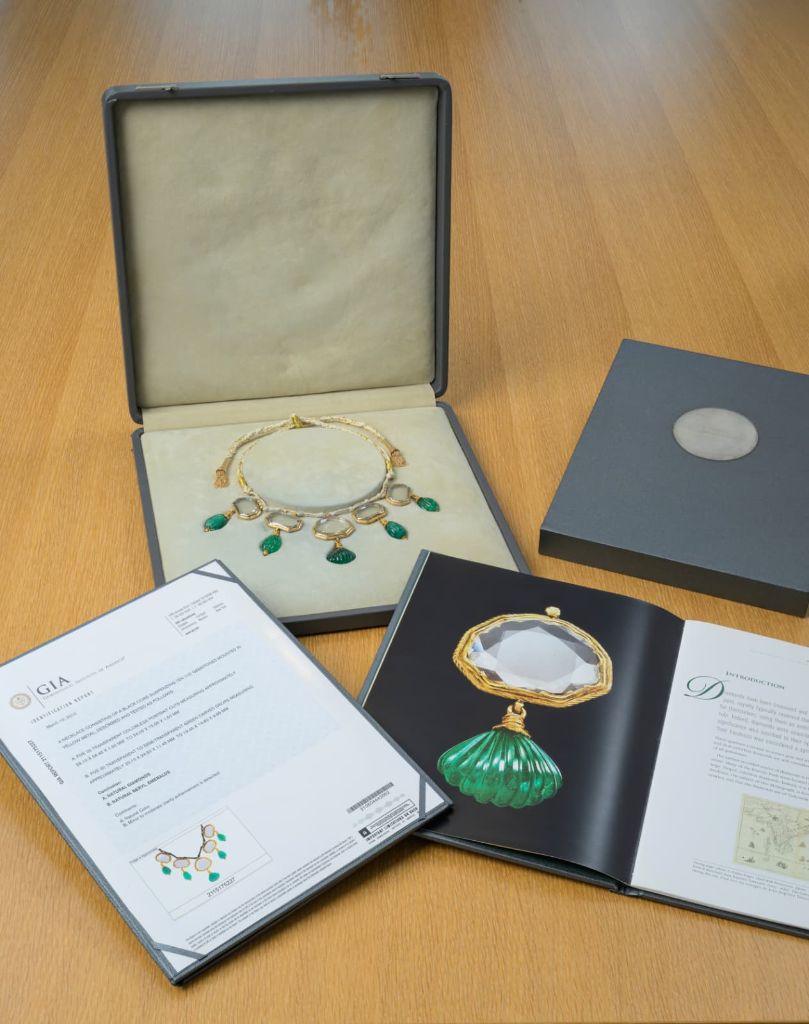
The supplied scholarly material situates the necklace within the Mughal court tradition of the Shah Jahan period, and references a continuous, verifiable chain of ownership along with gemological documentation, including a GIA identification report. In 2026, the necklace received public attention after Christian Dior Couture cited it as a design reference for a haute couture collection, describing it as "a masterpiece of Islamic design."
Every historical claim on this site is drawn from the supplied documentation, with careful, transparent attribution — see the full narrative and sources in the Knowledge Base.
Read the History & ProvenanceValue & Market Context
Documented expert estimates
Documented expert estimates place the total market value in the USD 70–100 million range, with a separately documented intrinsic value estimate of approximately USD 20–21 million; see valuation documentation for context and qualifications.
Enquiries
Request Private Information
Researchers, museums, press, and private collectors may request further documented information through our discreet inquiry process.
Request Private Information